
 Multilingual Website IT | EN | FR | DE
 The Archaeological Museum was born within the framework of a broader project for the recovery and functional redevelopment of the 17th-century Villa Altieri, launched by the Province of Rome – now the Metropolitan City of Rome Capital – starting in 2010, and aimed at establishing the “Palace of Culture and Historical Memory.”
The demanding restoration project was intended to create a multifunctional cultural hub, to house most of the Institution’s cultural services: from the Altieri historical collection, gathered in the ground floor specially converted into a museum, which also houses the temporary exhibition halls, to the Institutional Library and the Historical Archive, living organisms located on the second floor of the building.
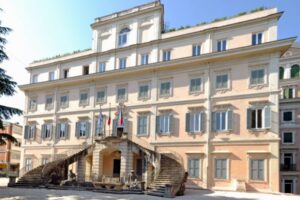
The large conference hall for cultural events was instead set up in the Gallery of the main floor, whose access from the façade is enhanced by the magnificent double semicircular staircase designed by Giovanni Antonio De Rossi, architect of the Altieri family, framing the fountain of the Tritons and Dolphins.
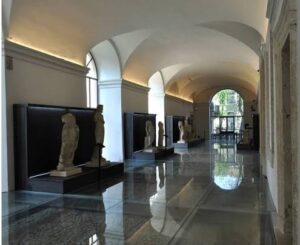
Since 2018, the year the new museum was opened to the public, several thousand visitors have been able to tour the museum section of the Villa, where what remains of the ancient family archaeological collection is displayed, along with a presentation of the archaeological context of the site.
A particularly interesting element is the glass elevation of the Loggia, which allows visitors to see the original basalt cobblestone flooring and the remains of the underlying Roman-era structures.
A demanding educational program also includes multimedia services available on site and cycles of specialized guided tours by reservation, designed as a free itinerary through diachronies and synchronies, from the protohistory of the site to the present day.
Recently, the Villa has hosted numerous temporary exhibitions, moving towards a symbiosis between classical and contemporary art.
History of Villa Altieri
 The ancient suburban villa of the Altieri family, of which today remain the noble Casino delle delizie and a portion of the garden, was built in the early 1670s, at the height of the Roman family’s splendor, when Emilio Bonaventura Altieri became pope under the name of Clement X (1670-1676).
A stately home and summer residence of the family, the Villa experienced a prestigious phase between the 17th and 18th centuries and was a destination of the Grand Tour. Visitors could admire the gardens with fountains, water features, and the large circular boxwood hedge labyrinth.
Alienated in 1858, the Villa entered a new phase when it passed to Monsignor Federico Francesco Saverio de Merode, who profoundly changed its function, transforming it into a female penal bathhouse in Rome (1872-1897).
The structure, intended to house female prisoners, went through a phase of suffering and rehabilitative experiments, but remained marked by a condition of profound inadequacy compared to its original function.
Subsequently, it was transformed into a boarding school for female students and then into an educational institution, maintaining an educational function until 2010, when the complex was returned to public utility through a redevelopment intervention.