
🌐 Multilingual Website IT | EN | FR | DE
Are you walking on the borders or inside an idea?

iosonovulnerabile is founded on three interconnected concepts - Communicating Artistic Organisms, Body-Beyond-Matter, Cosmic-Fabric-Weave - which together build a language capable of traversing art, philosophy, and the human condition.
Communicating Artistic Organisms (CAO)
The 'Communicating-Artistic-Organisms (CAO)' represent the beating heart of the 'iosonovulnerabile' project. They embody a new conception of contemporary artistic devices: no longer a fixed object or static symbol, but a dynamic process, in perpetual interaction with life and the surrounding reality. The CAOs draw inspiration from a tradition that embraces various artistic and philosophical eras, merging existentialism, phenomenology, and avant-gardes such as Dadaism and Surrealism.
For the CAO, art is a living organism: it breathes, grows, transforms, and inevitably deteriorates. Here resonates the thought of philosophers such as Henri Bergson and Gilles Deleuze, for whom life and time are elusive flows, resistant to fixation. Like Henri Bergson's concept of durée, which describes time as an indivisible flow of experiences and transformations, the CAOs liberate art from staticity, embracing continuous change.
The CAOs connect to Maurice Merleau-Ponty's phenomenology, where aesthetic experience is an interaction between subject and world. They are not merely to be contemplated but require active participation, involving the spectator both physically and mentally - the body not as an object among others, but as the medium through which the world reveals itself.
The form of the CAOs is fluid, always in flux, challenging the traditional idea of art as a search for perfection and permanence. Their transformation, subjected to natural processes, evokes entropy, a concept dear to the Arte Povera and Conceptual art of the 1960s and 1970s: works such as those of Joseph Beuys and Piero Manzoni find an echo here, where art is never fully defined but subject to continuous becoming.
Conflict and tension characterize the CAOs, embodying a dialectic between opposing forces: purpose and accident, aesthetics and ethics, past and present. In this, they recall Theodor W. Adorno's theories, for whom art is a negative force that reveals the contradictions of reality. The CAOs do not offer definitive answers but open spaces for critical reflection, exposing the ambiguity of human experience.
In their dynamism, the CAOs transcend conventional symbolisms to become relational mediums, recalling Nicolas Bourriaud's relational art, in which the work is a place of interaction rather than a completed object. Their experience is built through dialogue with the spectator, in a process of co-creation that dissolves the boundaries between art and life.
Body-Beyond-Matter
The concept of 'Body-Beyond-Matter' explores the complexity of the human body, transcending its materiality to reflect on its vulnerability, intimacy, and ability to communicate beyond physical boundaries. In a world dominated by virtuality and consumption, the body is rediscovered as a crossroads of physical, emotional, and spiritual dynamics.
At the foundation of this concept lies the idea that the body is not a mere physical object but an entity in continuous transformation. Philosophers such as Jean-Luc Nancy offer us a key to understanding this vision: for Nancy, the body is a field of forces that crosses the boundaries between inside and outside, between self and other - a relational entity, in constant dialogue with the world.
Vulnerability is seen here as strength, not weakness: it is openness, availability to be modified by the encounter with the other. The body becomes a medium of communication, a place of interaction, never static but in continuous evolution - recalling artistic practices that use the body as an instrument of exploration, where art becomes embodied experience.
The 'Body-Beyond-Matter' expands through e-motion, understood as movement toward the other. Emotions are not merely interior but shared experiences that connect bodies: the body, in this sense, is a field of possibilities, a place of encounter between inside and outside, between material and immaterial.
Cosmic-Fabric-Weave
'Cosmic-Fabric-Weave' is a concept that evokes a vision of the universe as an interconnected network of elements in constant movement and transformation. In this world, the differences between nature and culture, matter and spirit, order and chaos intertwine, creating new forms of existence.
Inspired by thinkers such as Friedrich Nietzsche and Bruno Latour, the 'Cosmic-Fabric-Weave' proposes a vision of the world as a complex and interdependent entity. The artist, far from the idea of finished artistic devices, explores the tensions and conflicts of reality, using materials that reflect the transience of life: ruin is not merely a sign of decay but a creative process. Art becomes a field of forces where matter and spirit meet, generating new forms - a living fabric that feeds on contradictions, keeping differences in tension, creating an 'aesthetic-of-convergence' experience.
The 'Cosmic-Fabric-Weave' also configures itself as a process of reappropriation of the real: art as a means to renew our relationship with the world, offering an authentic experience that involves body and mind. In an era of fixed and consumable forms, it reaffirms the value of incompleteness and convergence as fundamental elements for artistic creation and the understanding of the world.
A common language
These three concepts — Communicating Artistic Organisms, Body-Beyond-Matter, and Cosmic-Fabric-Weave - are not isolated but interconnected, forming a complex language that speaks of our human condition in all its vulnerability and strength. They invite us to reflect on our existence, our relationships, and our place in the universe, offering a space for contemplation, discovery, and transformation.
In an era in which art often fragments into forms and styles that risk losing contact with deeper reality, 'iosonovulnerabile' presents itself as a project that reaffirms the need to explore universal themes and to pass on these languages and concepts to future generations. It is an invitation to never stop questioning, seeking, creating, because it is only through this process that we can truly understand and embrace our vulnerability and, at the same time, our capacity to transform the world.
The exhibition path of 'iosonovulnerabile' intertwines with a much broader exhibition history, which since 2020 has brought the artist to galleries, museums, and festivals in Italy and abroad.
The path of 'iosonovulnerabile'
| Venue | City | Period |
|---|---|---|
| Villa Altieri – Palazzo della Cultura e della Memoria Storica | Rome, Italy | December 6, 2024 – February 23, 2025 |
| Italian Institute of Culture of Paris | Paris, France | September 3 – November 29, 2024 |
| Former Pontifical Prison of Velletri | Velletri, Italy | September 30, 2023 – January 30, 2024 |
General exhibition history
| Title | Organization | Venue | City | Period |
|---|---|---|---|---|
| VIII Rome Art Week | KOU Cultural Association | Studio SMIR | Rome, Italy | October 23–28, 2023 |
| XVIII Sociology Festival | Municipality of Narni / Minerva Association | M. Bortolotti Auditorium – San Domenico Complex | Narni, Italy | October 6–8, 2023 |
| Anthropocene Biennial | Vittorio Pavoncello | Scoglio di Quarto Art Space | Milan, Italy | September 19 – October 2, 2023 |
| XVIII Tracce – The Poetry of Water | Municipality of Narni / Minerva Association | M. Bortolotti Auditorium – San Domenico Complex | Narni, Italy | April 25 – May 14, 2023 |
| III Hanami – Sustainable Imagination | Academy of Fine Arts of Rome | Botanical Garden | Rome, Italy | April 15–16, 2023 |
| Anthropocene | Azioni d'Arte Cultural Association | Museum of Contemporary Art | Guarcino, Italy | October 22, 2022 |
| VII Rome Art Week | KOU Cultural Association | Studio SMIR | Rome, Italy | October 29–30, 2022 |
| V Artes – Sedimented Memories | Artes APS | Febo e Dafne Gallery | Turin, Italy | October 8–15, 2022 |
| Sustainable Imagination between Art and Nature | Lombardy Region / Municipality of Monza | Greenhouses Garden of Villa Reale | Monza, Italy | October 2–16, 2022 |
| Portraits in Scene – Art in Motion | Settimo Cielo Association | Aniene Valley / Piazza Marano Equo | Subiaco / Marano Equo, Italy | June 25, 2022 |
| Landscapes – Experiment for Canvas and Score | Settimo Cielo Association | Brancaccio Castle | Roviano, Italy | June 12 – September 9, 2022 |
| White Carrara | EU4ART / Academy of Fine Arts of Rome and Carrara | Piazza Antonio Gramsci | Carrara, Italy | June 6–17, 2022 |
| Anthropocene Biennial | Art G.A.P. Gallery | Rome | Rome, Italy | May 7–31, 2022 |
| Impossible Seats | Floracult | Casali del Pino – Fendi | Rome, Italy | April 23–25, 2022 |
| II Hanami – Sustainable Imagination | Academy of Fine Arts of Rome | Botanical Garden | Rome, Italy | April 8–10, 2022 |
| Another Dimension | Singulart | SingulArt Gallery | Paris, France | March 3, 2022 |
| Ex Tempore Before Xmas | Municipality of Isernia | Cloister of San Francesco | Isernia, Italy | December 18–23, 2021 |
| XXVI Saturarte | Satura | Palazzo Stella | Genoa, Italy | December 11–22, 2021 |
| Beyond Time | Circuiti Dinamici | Exhibition Spaces | Milan, Italy | November 21 – December 9, 2021 |
| VI Rome Art Week | KOU Cultural Association | Studio SMIR | Rome, Italy | October 29–30, 2021 |
| Decontest | Contesteco | Europe 2 Shopping Center | Rome, Italy | March–September 2021 |
| Myrooms | MyRoom | MyRoom | Palermo, Italy | March 6–19, 2021 |
| Radici Art Competition | Municipality of San Giuliano Milanese | Mario Tapia Radic Exhibition Hall | San Giuliano Milanese, Italy | February 18 – March 4, 2021 |
| XXXII Porticato Gaetano | Novecento Association | Gaeta Art Gallery | Gaeta, Italy | January 30 – March 31, 2021 |
| Human Landscapes | Alauda Association | Former Municipality of Adelfia | Bari, Italy | December 13, 2020 – January 17, 2021 |
| New Normal | Singulart | SingulArt Gallery | Paris, France | December 12, 2020 |
| XXV Saturarte | Satura | Palazzo Stella | Genoa, Italy | December 12–23, 2020 |
| What is Art | Bloomer Gallery | Bloomer Gallery | London, United Kingdom | December 4–10, 2020 |
| The Looking Glass and Behind It | Italian Institute of Culture of St. Petersburg / MISP | MISP Museum | St. Petersburg, Russia | November 11, 2020 – February 14, 2021 |
| Motion in Art | Singulart | SingulArt Gallery | Paris, France | October 23, 2020 |
| V Rome Art Week | KOU Cultural Association | Studio SMIR | Rome, Italy | October 26–31, 2020 |
| Emirates Art Connection | Fahidi Cultural Centre | Akaas Visual Artists Group | Dubai, UAE | October 19–24, 2020 |
| Emirates Art Connection | Ministry of Culture of Umm Al Quwain | Cultural Centre | Umm Al Quwain, UAE | October 13–17, 2020 |
| Let's Do It | McLuc Culture | Historic Centre | Parma, Italy | October 19 – November 7, 2020 |
| Let's Do It | Distretto A Association | Artistic District of Faenza | Faenza, Italy | October 10–24, 2020 |
| IV Artes – Flows and Beyond | Artes APS | Palazzo Birago | Turin, Italy | October 10–16, 2020 |
| III Mestre Painting Prize | Circolo Veneto Association | Candiani Centre | Mestre, Italy | September 19 – October 18, 2020 |
| Domani in Arte | Gallery of Modern Art of Rome | Gallery of Modern Art | Rome, Italy | July 28 – November 1, 2020 |
| 100 Painters at Palazzo Fani | ACTAS Tuscania | Palazzo Fani | Tuscania, Italy | July 16–28, 2020 |
| Noah's Ark | exfabbricadellebambole | Former Doll Factory | Milan, Italy | May 16 – September 19, 2020 |
| VIII Roma Ospita | La Scala d'Oro | Waldensian Church | Rome, Italy | February 15 – May 30, 2020 |
Abandoned in Velletri. For men who build careers and consider their mark on the world, this story offers something worth examining: what happens when creative force meets institutional decay, and how confronting vulnerability becomes an act of leadership.
The Festival of Cinema NYC does not distribute recognition lightly. Supported by the National Endowment for the Arts, the New York State Council on the Arts, and the New York City Department of Cultural Affairs, it represents serious cultural validation. That the prison-born film of director Sergio Mario Illuminato earned this recognition suggests that American cultural institutions recognize something profound in his approach to abandoned power structures.
When Papal Authority Becomes Artistic Canvas
The former Pontifical Prison of Velletri, 40 kilometers southeast of Rome, embodies institutional power in physical form. Built in the 19th century under papal authority when the Catholic Church governed central Italy, this imposing structure served both as a courthouse and detention center for the Papal States. For over a century, it housed prisoners, witnessed trials, and embodied the judicial system of a bygone era.
Closed in the 1990s as Italy modernized its penal system, the building stood empty for three decades. In 2023, facing demolition, it seemed destined to be erased from history. What followed offers a compelling case study in how spaces designed for control and punishment can become laboratories for creative expression.
Similar transformations have occurred across continents. Philadelphia's Eastern State Penitentiary now hosts site-specific installations addressing themes of incarceration and justice. Alcatraz Island attracts over 1.4 million visitors per year to see art exhibitions exploring the prison's layered history. These spaces share something crucial: they demonstrate how places built to contain and control can become platforms for examining power itself.
Artists Enter the Void
Before demolition could proceed, painters, photographers, dancers, and musicians claimed the Velletri prison as their temporary home. For six months, they inhabited decaying cells and darkened corridors, transforming every corner into a creative laboratory. This act of appropriation carries weight: by taking control of a site built to confine, these artists reversed the building's original purpose.
The group included choreographers Patrizia Cavola and Ivan Truol of Compagnia Atacama, photographers Federico Marchi and Roberto Biagiotti, and sound designers Andrea Moscianese and Davide Palmiotto. Their collaborative work became both performance and documentation, creating what would become VULNERARE.
This approach to abandoned institutional spaces reflects a broader cultural shift. At Fremantle Prison in Australia, extensive inmate art spanning 136 years of operation provides insights into prisoner experiences and cultural expression. These examples suggest that creative work in former sites of detention serves a deeper purpose than mere spectacle: it redefines how we understand power, memory, and human resilience.
The Film's Approach: Threshold Cinema
Illuminato's methodology, which he calls "THRESHOLD CINEMA", captures authenticity through improvisation and spontaneity. No script, only life as it happens. This approach produces what he defines as "Communicating Artistic Organisms" – living works that change and transform before the viewer's eyes.
The film's visual language moves from black-and-white images of the prison's past to explosions of color representing rebirth. Dancers perform in claustrophobic cells, transforming them into stages of freedom. The soundtrack guides viewers from prison drama toward creative possibility.
Media historian Bruno di Marino notes how "walls, floors, ceilings become cuts, wounds, rifts. Choreographic gestures and pictorial matter merge into a single visual score through surgical editing and plays of light."
Why It Speaks to Men of Influence
Contemporary leadership research increasingly recognizes vulnerability as a core strength rather than a weakness. Leaders who embrace vulnerability build trust, foster authentic connections, and create collaborative environments.
The VULNERARE project embodies this principle in physical form. Illuminato describes the prison as "a contemporary cathedral of vulnerability" where art expresses rebirth. Vulnerability thus becomes an interpretive framework for power.
From Wounds to Beauty
The film closes with words carved into a wall: "Vulnerable therefore alive, art is loving reality". Hidden in the audio track, a message appears in Morse code: IAMVULNERABLE. Recognizing vulnerability does not mean weakness, but presence.
As another wall inscription reads: "The cuts on the skin are not an illusion, they no longer heal." The marks become art precisely because they are acknowledged.
VULNERARE brings Italy's voice to America, showing what happens when wounds become generative possibility. Entering abandoned spaces means restoring a voice to what had been removed.
There are three levels of representation that intertwine in Vulnerare, three levels that then generate — in its unfolding — as many more, evoking suggestions and emotions in the viewer's mind.
The first concerns the location: a disused prison specifically, although the setting recalls an almost transversal genre of audiovisual work — the re-staging of dismantled and dilapidated spaces that evoke a more or less recent past and breathe with more or less painful memories (from Bourbon penitentiaries to pre-Basaglia psychiatric hospitals, though this long list also includes 1980s discotheques).
The second level is performative: dance becomes in some cases the means of reclaiming these sites, symbolically restoring life to them.
The third level consists of the insertion of certain works — created by the artist-filmmaker himself — into the space explored by the camera: abstract paintings that, placed inside the cells that once held inmates, transform the place into a kind of museum, loading it with further meanings while themselves being invested with new meanings through the space into which they fit perfectly, almost as if camouflaged.
The intent of Vulnerare is to merge visual art, dance, and cinema, with the addition of a highly effective sound commentary where music becomes noise and noise becomes music (composed by Andrea Moscianese). But also to construct a possible narrative, to which contribute the writings of those who lived here for years, locked within these walls, the objects, the trial folders evoking a Kafkaesque bureaucracy, the plants that have sprouted through the concrete reclaiming what was taken — and finally, all the possible traces and testimonies of a temporal dimension that continues to reverberate in the desolate emptiness.
Before the closing credits, a caption informs us that the prison we have entered is the Pontifical one of Velletri, though it is information that adds little to our viewing experience. What remains are the surfaces that Illuminato's gaze allows us to perceive almost tactilely.
Walls, floors, ceilings, doors, windows that become cuts, wounds, faults, caesuras, while the choreographic gestures — inscribed within this geometry of architectural solids and voids — and the pictorial matter on canvases hung or leaning against walls amid the debris, become moments of a single visual score through handheld camera tracking shots, dissolves, chiaroscuro effects, luminous intermittences, rapid zooms, close-up details, and sudden cuts punctuated by surgical editing.
Vulnerare can, finally, be read as a single installation. And in this sense, the presence of Illuminato himself within one of the courtyards seems to close the circle. The artist's silhouette, seen from above, gazes at a phrase — or perhaps two connected ones — that someone has written on the wall: "Vulnerable therefore alive. Art is loving reality."
Vulnerability represents a weakness in that a person can become the victim of others, but it is also their strength, as one who is conscious of being alive even within pain. The artist too is vulnerable in the moment of confronting reality, immersing themselves within it.
The awareness that making art inevitably means loving reality is not a universally valid premise. It certainly does not hold for those artists who, through creation, seek to escape the dimension in which they live.
But in this case, the task of the artist is to recount the human condition within the concentrationary universe, and what remains of people's dignity even when deprived of their freedom.
The screening of the short film VULNERARE represents a symbolic moment in the life of the project, which unfolds across several sites: IOSONOVULNERABILE had its inception last January through an artist residency in the abandoned spaces of the former Pontifical Prison of Velletri, before travelling to Paris and continuing next December in the seventeenth-century rooms of the Museo Storico di Villa Altieri in Rome.
IOSONOVULNERABILE is a complex project in which human vulnerability — with the fears, defeats, and weaknesses that accompany the earthly experience of individuals — is narrated and, if one wishes, exorcised and transformed into emotion through various artistic forms such as photography, cinema, choreographic art, theatre, music, set design, and publishing.
The importance of the project is highlighted by the Director of the Italian Cultural Institute of Paris, Antonio Calbi, through the following words: "Culture is an opportunity for education and growth, and sometimes also for fighting injustice. The first step in doing so is to accept our own fragilities — in a world that continues to demand perfection, we choose to celebrate vulnerability, the beauty of the simple, pure gesture."
VULNERARE: a material short film
The debut work of Sergio Mario Illuminato, just over 13 minutes in length, presents itself as dense with meaning, originating largely from the observation of matter. Shot inside the former Pontifical Prison of Velletri — built in 1860 and decommissioned in 1991, now on the verge of a change of use — the film unfolds as a series of images, both in colour and in evocative black and white, in which the past is revealed: or rather, the echoes of multiple lives (suffering ones, this being a prison) that were expressed and repressed within those spaces.
Nets, bars, doors, metal frameworks, folders piled on the floor, writings on the walls, and corridors are the protagonists of the short, but not only. Intense performative moments are found in choreographic actions that evoke the corporeality of the humanity that once inhabited those places, as well as shadows that recall sediments of life, bound to a confused memory seeping from flaking walls, where the worn surface itself becomes meaning.
Matter as an expression of reality
During the screening of the audiovisual work — enriched by an "edgy" soundtrack by Andrea Moscianese — one has the sensation of evoking deep emotions not only through sight, but also through an almost tactile perception of the images and objects shown.
Opening those dusty folders and scrolling through the names of those who lived in those places in the vulnerability of the condemned embodies a desire felt by the viewer. Each name calls forth an individual, a story, a marked life, often lost in the silence of a history that preserves the victors more than the defeated.
The short does not indulge in self-referential tendencies or in exclusionary visual languages, but seeks a direct communicative channel with the present, speaking of memory and time, and of the places in which this memory has settled.
On the subject of the tactile sensation evoked by the film, one inscription on a wall stands out: "The cuts on the skin are not an illusion, they no longer heal" — which seems to condense the impact of reality on the lives of individuals, leaving indelible marks.
Art is loving reality, whatever it may be
The title of the short derives from the Latin vulnus, meaning wound, offence, damage. In Illuminato's film these wounds appear irreparable: writings on walls, names in registers, traces that outlast the duration of the sentence and the subject themselves.
This is not only about the past, but about a memory that remains active, presenting itself as living matter. The film invites us not to regard the past as distance, but as an experience to be brought into the present, embracing vulnerability as an essential condition of our relationship with reality.
In this sense, the artistic gesture becomes an act of exposure: showing one's wounds, acknowledging one's fragility, accepting the impossibility of total control.
In this perspective, the closing reference to the words of Pier Paolo Pasolini also finds its place, evoking a world in which it is possible to fail and begin again without losing dignity.
From this emerges a final admonition that runs through the entire work: "vulnerable therefore alive, art is loving reality."
'iosonovulnerabile' is a project that is broadly "performative" in nature, inherently complex because it is made up of many paths that reconnect, at times, with one another. These many paths are the exhibited works, the author's reflections that accompany them, the references to past and present — Tàpies, Kiefer, Parmiggiani — and not least the exhibition space where everything happens and regenerates itself through those who move through it.
But complex also because it is aware of the functional limits that works of art have as symbolic language in relation to the fluidity of the processes that concern and involve us. Bodies, wrote Jean-Luc Nancy in Corpus, "are always on the verge of departing, in the imminence of a movement, a fall, a withdrawal..." — that is, they are not forms to be fixed like stable architectures, nor, in the sense of classical physics, consistent particles, but states of potential and relative movements. In other words, bodies inhabit and places are shaped by their inhabitants.
The "dispositif" — a term that frequently recurs in Sergio Mario Illuminato's reflections — is a mechanism made, precisely, of multiple parts in relation to one another, not so much in a mechanistic and therefore formal sense, the product of compositions and measurements, but parts that hybridise through continuity. The dispositif, as a complex organism, thus underlies a sensibility that filters through the various elements: works and place. Everything is closely connected, so much so that the thought (perhaps one should say the spirit) that circulates among the various media (the paintings, the text, the place) is the true dispositif without definitive form — just as life, of which "corpus" and "vulnus" are the raw material, has no definitive form.
From this relationship arises the idea of the exhibition path, as well as of the path of thought that precedes and inhabits it. That "a good painter is inwardly full of figures" was a reflection by Albrecht Dürer, taken up by Salvatore Settis as an epigraph for one of his texts in the catalogue of Anselm Kiefer's exhibition at the Palazzo Ducale in Venice in 2022. Kiefer too has maintained that he thinks in images, aided by poetry.
Attempting to clear some of the clouds inherent in metaphors: bringing different media into convergence is typical of the post-medial nature of contemporary sensibility, even when it comes to painting-as-painting, as in the case of the Corpus et Vulnus of 'iosonovulnerabile'. Painting, however, that needs to nourish itself beyond the frame of composition, inhabiting a powerful, site-sensitive space — such as the former Pontifical Prison of Velletri — in order to place "at the centre the extremely fragile condition of human reality", as the author writes; giving form to a matrix-thought of processes, such as Nancy's, in order finally to engage a regenerating dialogue that begins in the moment of exhibition.
For this reason, one can also speak of a "performative" sensibility beyond the overly narrow grammar of languages, because works of art too can function as performers in a field of relations activated by them. We have been conditioned to introject painting as an inscrutable and self-sufficient sacred reality, to be viewed from a distance, as though it were an island where one cannot land. Whereas "to see painting — argues William J.T. Mitchell in his Pictorial Turn — is to see touching, to see the gestures of the artist; that is why — Mitchell deduced — touching canvases is so rigorously forbidden."
Working on the exhibition, instead, as though it were a biographical narrative that reveals the author's position within a problematic field of relations, is a way of unveiling the work by making its process — and therefore its vitality — felt. Visual media do not exist, Mitchell further argued, wishing to make the case that there are no "pure" media, since our senses cannot act autonomously, as we exist within a body-organism.
The Corpus et Vulnus of 'iosonovulnerabile' form a sentient and communicating organism whose signs are certainly not abstract illustrations of concepts, but matrix-concepts in themselves, as constituent parts of a living and proliferating organism.
Prof. Franco Speroni, writer, art historian and critic, lecturer in the history of contemporary art and the history and methodology of art criticism at the Accademia di Belle Arti in Rome.
I too, through wandering, have understood. Through failing, I have found words. I have taken a step back and, in this condition of slender evidence, mystery and beauty, I can tell you now of the birth and the shifting course, I can narrate a 'love story' that contains and preserves the secret of its own name and appears in its unmistakable dimension of body and skin.
The 'Communicating Artistic Organisms' of Sergio Mario Illuminato come to life in a relationship of declared reciprocity that takes on the appearance of a process of reiterated antagonism.
It is a heartfelt dialogue, a confrontation without defences, a defenceless dance: between the artist and the extension of his arm, the essential derivation of his substance, a continuum between being of human making and the world — a fabric of visions, breaths, desires.
In the moment of origin, in emitting the first cry, every pigment, every small portion of matter undergoes biological existence, added to and subtracted from by the creative fortress of one who has always thought it, wanted it, loved it.
But in that same instant it rises from the earth, discovers its innate autonomy, forces its maker to surrender. It is not an unequal struggle, and the artist, anticipating forthcoming events, withdraws, admits his wandering, kneads failure together with colours, with filaments, with substances, unable to escape what he has always known.
Every element becomes body, skin, organ: within it everything deteriorates, everything decays, everything decomposes, everything reconstructs and regenerates itself, everything renews itself at the passing of sun and dust, wind and rain, of the air itself in its composition of nitrogen, oxygen, argon, carbon dioxide and those other microscopic elements that take on the form of seas, of territories, of the manifold activities on the surface.
Every Organism recognises its constitutive quality, a 'Cosmic-Texture-Weave' that breathes the fragile essence of what it realises: it discovers itself to be a cultural device of being nature, a mechanism of communication with whoever wishes to graze it, observe it, touch it.
It metamorphoses into a place of truth and draws near to the underworld of the sublime, of the eternal spirit that underlies the ages. Stripped of mere aesthetic value, it becomes aware of its intimate solitude, suppressing distances, arriving at silences and narratives, making space for all that is not itself, that distinguishes itself from it.
It becomes the dream of the common and traces possible futures, re-creating, re-pairing, re-being born, emerging from the present, from the hic et nunc, in a desperate will that illuminates our wretchedness.
The 'Communicating Artistic Organisms' compel us to look, even as they whisper our ephemeral freedom: they demand a return to memory, to the ruins of our small souls, containing within them the desperate times of our lives and our fragile communities.
They reveal the love-the loving-the beloved of every single phase of becoming, and speak of the friable, vulnerable realities we experience in a continuous cycle of beginning and end.
In every manifest presence, they yield to other images, to other figures, actions, voices; they take root in space, become permeated by it, conform to landscapes, capture their imprints, freeze them only for an instant in moments of safety, then restore their unforeseen transformations, depictions, representations.
And we, spect-actors, co-creators with the work and with the artist, become part of the same play of forces, and in the symbiotic exchange of skin — interactive interface of tensions and perceptions — we return to that forgotten day when, taking our first steps, every fall is a rediscovery of new knowledge and unprecedented conquests.
We re-learn to see, to feel, to reach, to interweave, to carry words — strange and incommensurable, far from being perfectible: they endure and perpetuate themselves, without fear of being questions of love.
Time and space are the domain in which life unfolds; at once, possibility and limit.
We have always sought — or imagined — a way to avoid remaining confined within this assigned space, within this limited time; yet we also desire a cage in which to shelter from the evil of the world, a protection against the risk of no longer existing.
These enclosures, these limits, often take a square form; it seems simpler to us, more effective — in the square we somehow reassure ourselves. Perhaps this is why works of art have so often taken this form, enclosing and defining a space within which to express the condition of those who, like us — already slaves to time — seek in this way to use space to their advantage.
This is what Sergio Mario Illuminato enacts: in the conquered space of VULNERARE he carries out an alchemical transformation using the material world — stones, colours, plants, objects, and above all fire — to arrive, through the "Opus ad Rubeum", at the ideal goal of alchemy, the ultimate aim of those who pursued the transcendence of life's limits: eternity, immortality. That cancellation of time which myth associates with sleeping — and above all dreaming — upon the tombs of one's ancestors, which would thereby allow communication with them. And this all the more so during the summer solstice, when the sun no longer casts shadows upon the world; since time is witnessed and made visible precisely through shadows, there occurs in this way a stasis of time, and the annihilation of the distance between those who were present in the past and those who are present today.
This also underlies the fascination that ruins exert upon us (many of Sergio Mario Illuminato's works are ruins of the present, deliberately sought contemporary vestiges): the perception of presence, the ability to touch, to come into contact with something that has witnessed a time distant from today yet still exists, alongside us.
The present of the past reaching out to touch the present of the present, thus annulling the time that had intervened between the two, and giving concrete form to a fundamental human desire.
Time and space are the domain in which life unfolds; at once, possibility and limit.
We have always sought — or imagined — a way to avoid remaining confined within this assigned space, within this limited time; yet we also desire a cage in which to shelter from the evil of the world, a protection against the risk of no longer existing.
These enclosures, these limits, often take a square form; it seems simpler to us, more effective — in the square we somehow reassure ourselves. Perhaps this is why works of art have so often taken this form, enclosing and defining a space within which to express the condition of those who, like us — already slaves to time — seek in this way to use space to their advantage.
This is what Sergio Mario Illuminato enacts: in the conquered space of VULNERARE he carries out an alchemical transformation using the material world — stones, colours, plants, objects, and above all fire — to arrive, through the "Opus ad Rubeum", at the ideal goal of alchemy, the ultimate aim of those who pursued the transcendence of life's limits: eternity, immortality. That cancellation of time which myth associates with sleeping — and above all dreaming — upon the tombs of one's ancestors, which would thereby allow communication with them. And this all the more so during the summer solstice, when the sun no longer casts shadows upon the world; since time is witnessed and made visible precisely through shadows, there occurs in this way a stasis of time, and the annihilation of the distance between those who were present in the past and those who are present today.
And then again the writing, hidden this time in the ancient, abandoned, now useless folders of past trials, of sentences concluded with the end of the time in which they were handed down; but these are not pages — they are the lives of men who, by those sentences, were confined for years, sometimes forever, within an immobile frame of stone built around them and their souls.
We see Sergio Mario Illuminato's device 'Divieto di Fissione' — split, ruined, wounded, a fascinating ruin in its being there to bear witness to uncertainty, to the incredible and ineluctable imperfection of life. But then immediately the image of a human being tracing with their limbs the boundaries of a liveable space, trying to give meaning to a place that has none. Perhaps this is what we all do to some extent, moving within our non-apparent prison, toward something that makes us feel truly alive.
And in another device, 'Collisione', a furrowed, incised terrain whose infinite fractures also suggest the idea of something fertile, potentially capable of generating life — much as furrows do in a field.
Then thousands of sheets that are people — sheets as ruins remaining to bear witness to the absence of those who lived confined in the present of a past time.
More writings appear, scratched names of people — names are people — on the walls, and in the works of Sergio Mario Illuminato.
One of these is plaster and colours spread over a cage that is at once bars, closure, and support, a foundation. And then paper burned, destroyed by fire, transformed by fire — a Phoenix seeking resurrection from its own ashes, as though it were necessary — in order to truly live — to first destroy apparent reality with fire. As though one must inevitably pass through that red, the alchemists' destructive heat, toward the definitive transformation, the True.
Yet another square, 'Le Quattro Stagioni del Presente' — one more, multiplying this time into four square fields while simultaneously becoming a window. Because a square can be both a limit and an opening. And a cross; before which (or perhaps within which) bodies dance, becoming crosses themselves, opening their arms. Bodies that leap, seeking a possible space, a possible life, together; there are two of them, they help each other, embrace, look, love, and in their being together the pain melts and falls away. A dance that is a possible way out, a salvation to be reached together, overcoming the limits of egoism and isolation, toward the desire for a union of love that can save us, that must do so.
They dance before a square, in a closed room, attempting to give form and meaning to time and space.
And who knows whether that dancing couple, that "One plus One", might not succeed in giving life to something new, unprecedented — a "Three" that did not exist before and of which we feel such need in our journey as prisoners; we need this "Three" that can only be born from truly seeking it together, and not alone.
Creating the "Three" can finally and truly allow us to leave the cage of time and space. A "Three" that is our living, speaking, singing, dancing, playing music — but together; that is our running, loving, smiling at one another, looking at one another, embracing one another even with a cross behind us, and it is our possible salvation. A salvation that is truly such not because it escapes time or space, but because it interprets them, makes use of them; and this is what occurs in the work of Sergio Mario Illuminato.
The final image of the film is the square courtyard (the frame) of the prison — space and limit for the many who, in the present of a distant past, inhabited it during that single hour in which they could attempt to restore to their existence the space of the sky. That infinite space above oneself which is the only — yet fundamental — difference between a courtyard and a room. That sky capable of making us feel (or believe — but does it truly make a difference?) that we will have more space, more time, that not everything is destined to vanish.
A sky before our eyes, to be transferred into the heart; to be kept for when life seems to us a prison without exit, a concluded time.
And it is beneath this sky, conquered for the gaze, that our being vulnerable, our wounds, become a testimony of possible life — as the inscription that appears on the wall at the end of the film declares: "vulnerable therefore alive, art is loving reality."
Perhaps loving reality truly is an art; and Art the only way, our sole possibility of truly looking reality — and ourselves — in the eyes.
Sergio Mario Illuminato was one of my students at the Accademia di Belle Arti in Rome, just before the pandemic broke out and during the lockdown.
Before practising art, he travelled along a parallel cultural track that allowed him to remain constantly in tune with contemporary artistic debate, studying and absorbing much of what was being discussed on the international scene.
As an attentive observer, he refined his critical thinking, clarifying through analytical introspection the reasons for his sensibility, and making very precise choices within the varied and vast panorama of contemporary art.
He identified from the outset his masters and references in artists such as Antoni Tàpies, Anselm Kiefer, and Claudio Parmiggiani, and nourished his knowledge with theoretical and philosophical contributions from scholars and maîtres-à-penser such as Martin Heidegger, Gilles Deleuze, Jacques Derrida, Gianni Vattimo, Maurice Merleau-Ponty, and others.
It is around these references that his language took shape and developed — one that takes into account what has already occurred in the recent history of art, while tracing a path with its own recognisable physiognomy.
His is a poetics that feeds on the data and signs of time and existence: a direct connection between art and life, from which he captures not only its energy and exuberant vitality, but also its painful agony, precariousness, and fragility.
It is no coincidence that Sergio Mario Illuminato turns his attention toward places that harbour unease and suffering — what he himself calls contemporary cathedrals of vulnerability: prisons, psychiatric hospitals, hospitals, migrant boats...
Indeed, his exhibition project Corpus-et-Vulnus opens precisely in the rooms of the former Castello prison in Velletri.
Sergio Mario Illuminato immediately grasped the semantic value and the unsettling, controversial fascination of this imposing building — today abandoned and in decay — where numerous court archive files lie scattered, chaotic and piled up. Erased, dispersed and annulled lives, traces of human existence, of unspeakable despair, transcribed in crumbling dossiers.
It is in this context that the meaning of his work becomes clearer, placing aesthetics and ethics in close alignment.
There is nothing decorative or aestheticising in these works, yet equally no self-indulgence or ideological winking. No journalistic-narrative temptation and no desire for symbolic representation — rather, a living of painting in its elementary, primary, and original language: form, light, colour, matter, obeying the specific and intrinsic reasons of painting itself, free from useless formalisms and mental attitudes of rhetoric and pretextual engagement.
He recovers those now historical references of the Informel, and within this area — this introspective and meditative phenomenology — he has undertaken his painterly journey, rich in unforeseeable events and attentive to the profound reasons of the human condition.
And this attentiveness is recorded and impressed in the textures and sedimentations of a painting that, without pretence or premeditation, surprises through its poetic outcomes and its sense of adventure.
Prof. Giuseppe Modica, painter and lecturer in painting at the Accademia di Belle Arti in Rome
We are all students. Even those who are now professors, if they take seriously their own condition and their role, are students. One never finishes learning, and one can never be satisfied with the little or the much that one knows or believes one knows.
This is why I have allowed myself to title this reflection on the work of Sergio Mario Illuminato in a way that is only apparently provocative.
Technically, Sergio Mario Illuminato was one of my students, but my students are my teachers, because from them I learn to understand how best to recount the little that I know. Not to teach — to recount. Little or nothing can truly be taught, and Socrates explained this to everyone: to know something, anything at all, one must look inward and seek there what we seem to see outside ourselves. If we cannot find it within, we will never be capable of learning it.
Saint Augustine wrote it in clear terms in De vera religione: Noli foras ire, in teipsum redi, in interiore homine habitat Veritas (XXXIX). And so, we learn from one another to look within ourselves.
Sergio Mario Illuminato — whose surname does not appear to be accidental (nomen omen, that is, "a name, a destiny") — has interpreted this maxim, turning it into a method of reading both ourselves and reality, as well as an art movement: because, looking within, we cannot help but recognise that we are fragile.
He began with his degree thesis, entitled Corpus et Vulnus, and then continued with exhibitions and various initiatives, always in the wake of Duchamp — such as Vulnerar(t)e, a path never closed nor to be closed, because it corresponds to life itself.
The most recent initiative was held at the former Pontifical Prison of Velletri — a space of over one thousand square metres built in 1861 by the Romani family, today abandoned — brought to life by a group of students, painting and sculpture technicians from the Accademia di Belle Arti in Rome, as well as lecturers and professionals in photography, cinema, dance, and music.
From this was born the transdisciplinary project 'iosonovulnerabile', which from its very title carries a double value: a reference both to the architectural complex and to all those who will rescue it from oblivion by adding their own fragility to its own.
Indeed, the fragment, memory, synaesthesia, the double territory of exterior and interior, metamorphosis and alchemy — these are the ingredients of Sergio Mario Illuminato's art. Like a new Wanderer above the Sea of Fog, he pauses at the threshold of his own soul to transform the surrounding reality into the incandescent matter of his canvases.
Contemporary artistic training can no longer be limited to the mere acquisition of technical skills; it must also include the capacity to engage with a globalised and constantly changing world.
In this context, the Accademia di Belle Arti has the task of preparing students to become citizens of the world, capable of using art as a means of expression, communication, and social transformation.
Participation in the project 'iosonovulnerabile' forms part of this intensive and personal research, aimed at broadening the cultural and creative horizons of sculpture students, stimulating a profound reflection on the role of art in contemporary society.
Andrea Emo maintained that art is the transformation of a sensibility into an activity — a mysterious transformation that is the very essence of thought. Art as the consciousness of action.
The sculpture entitled 'Jonchets, o Sciangai', created by the group of young artists from the Accademia di Belle Arti in Rome, represents an emblematic example of this process of transforming action into consciousness.
Within this action-consciousness resides its entire development of being-not being: 41 sticks that, in dialectical and synergic relationship with the other artistic devices placed in the "form and space" of the garden-laboratory and in the presence of the majestic colonnade designed by the Italian architect Luigi Moretti in 1953, render recognisable and distinctive the artist's intuition — the intuition of the present: not surrendering in the face of the world's complexity.
Through the artistic research promoted by Sergio Mario Illuminato, students are immersed in a dynamic and integrated process that functions as an instrument of dialogue and integration with a variety of creative languages, engaging the institutions supporting the project and addressing critical and intercultural themes.
The importance of the non-profit transdisciplinary research of 'iosonovulnerabile' lies in its capacity to transcend national borders and break down the barriers between viewer and artwork, thereby enabling the construction, from Italy, of an international artistic community capable of exploring the challenges of the contemporary art world.
The archaeological museum was established within the context of a broader project of recovery and functional redevelopment of the seventeenth-century Villa Altieri, launched by the Province of Rome — today the Metropolitan City of Rome Capital — from 2010 onwards, with the aim of creating the "Palace of Culture and Historical Memory".
Through this ambitious restoration project, the intention was to establish a multifunctional cultural hub, to serve as the home of the majority of the institution's cultural services: from the historic Altieri collection, housed in the purpose-museified ground floor — where the temporary exhibition rooms are also located — to the institutional Library and the Historical Archive, living organisms situated on the second floor of the building.
The large conference hall for cultural events was instead set up in the Gallery of the piano nobile, whose façade entrance is enhanced by the magnificent double semicircular staircase created by Giovanni Antonio De Rossi, architect to the Altieri household, and the setting of the Tritons and Dolphins fountain.
Since 2018, the date of opening to the public of the new museum, several thousand visitors have been able to tour the museified section of the Villa, where what remains of the ancient family archaeological collection is displayed, alongside a presentation of the archaeological context of the finds.
An element of particular interest is the glazed superstructure of the Loggia, which allows a view of the original basalt-flint cobbled flooring and the remains of the underlying Roman-era structures.
An ambitious educational project also provides multimedia services available on site and cycles of specialised guided tours by appointment, conceived as a free itinerary through diachronies and synchronies, from the prehistory of the site to the present day.
Recently the Villa has hosted numerous temporary exhibitions, moving in the direction of a symbiosis between classical and contemporary art.
History of Villa Altieri
The ancient suburban villa of the Altieri family — of which the noble Casino delle delizie and a portion of the garden survive today — was built in the early 1670s, at the moment of greatest splendour of the Roman dynasty, when Emilio Bonaventura Altieri became pope under the name of Clement X (1670–1676).
A prestige residence and summer retreat for the family, the Villa experienced a period of prominence between the seventeenth and eighteenth centuries and became a destination on the Grand Tour. Visitors could admire the gardens with fountains, water features, and the great circular labyrinth of box hedges.
Sold in 1858, the Villa entered a new phase when it passed to Monsignor Federico Francesco Saverio de Merode, who profoundly altered its function, transforming it into a women's penal bath-house in Rome (1872–1897).
The structure, intended to house female inmates, underwent a period of hardship and rehabilitative experimentation, yet remained marked by a condition of profound inadequacy in relation to its original function.
It was subsequently transformed into a boarding school for young women and then into an educational institution, maintaining an educational function until 2010, when the complex was returned to public use through a redevelopment intervention.
Contemporary art and historical memory
In an era in which the intermingling of classical and contemporary art is no longer experienced as provocation, the need to overcome barriers between artistic languages and historical periods asserts itself.
The archaeological museum thus becomes a place of dynamic relationship between ancient memory and contemporary artistic production, fostering new forms of cultural reading and creation.
In this context, initiatives such as Io sono Vulnerabile take on a specific value, grounded in the connection between exhibition space and the theme of vulnerability.
The project brings into dialogue two "prisons": the Pontifical Prison of Velletri and Villa Altieri itself, which retains traces of its original custodial function, creating a dialogue between container and content.
Vulnerability thus emerges as historical experience, human condition, and paradigm of the mutability of time, inscribed in places and their stratifications.
ROME, MAXXI - National Museum of 21st Century Arts
ROME, Villa Altieri Museum
PARIS, Italian Cultural Institute of Paris
VELLETRI, former Pontifical Prison of Velletri
THE COMMUNICATING ARTISTIC ORGANISMS
|
MILIEU (286x184x05) foglie d’oro, pigmenti organici su tela con intonaci e contatore elettrico d’inizio secolo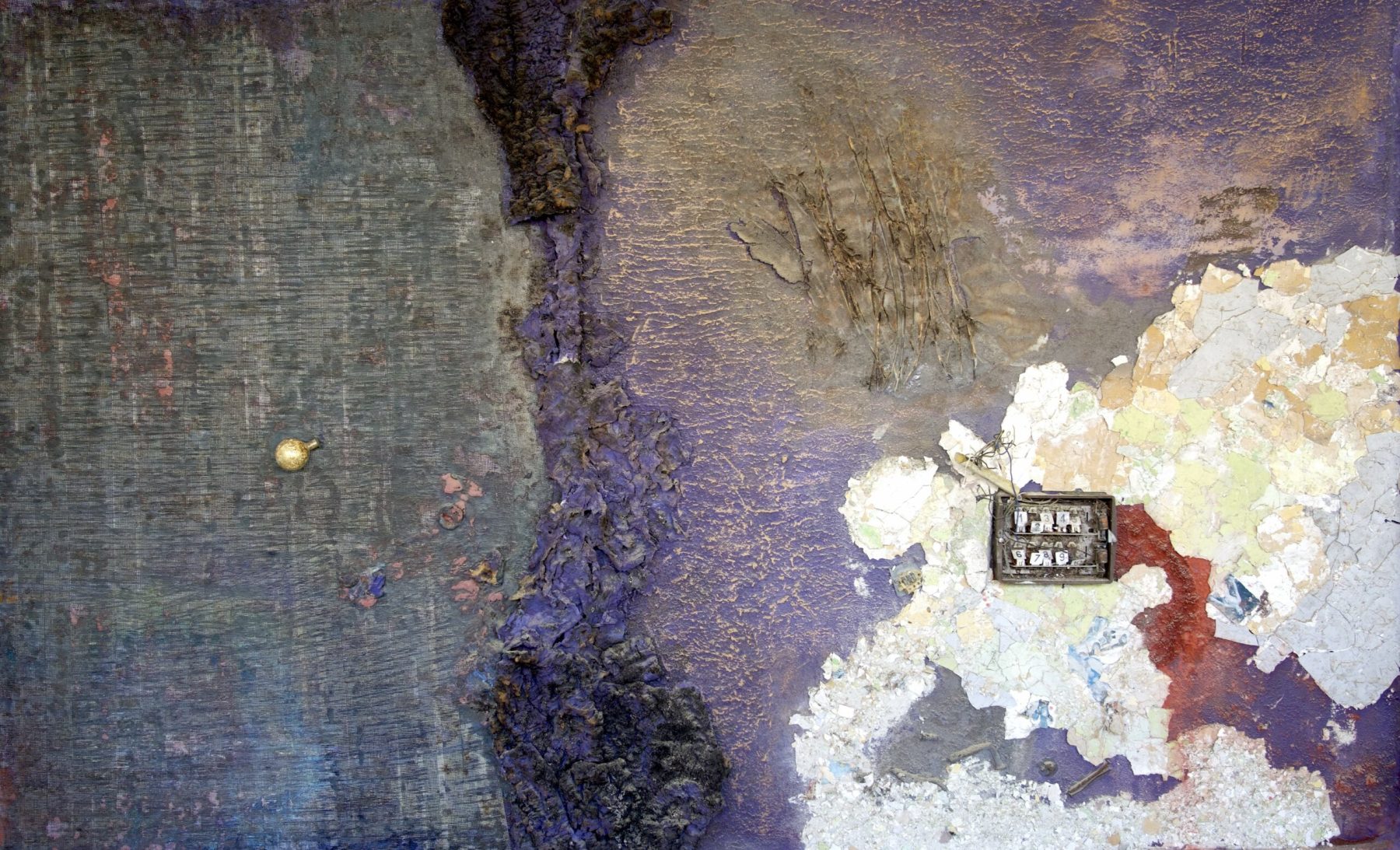
Il dispositivo artistico ‘Milieu’ presenta una composizione stratificata in cui materiali naturali e industriali dialogano. A sinistra, una bolla dorata si staglia su uno sfondo scuro e opaco, in contrasto con la sezione destra, più luminosa e frammentata. Questa dualità crea una tensione tra due mondi: uno chiuso e enigmatico, simboleggiato dalla bolla dorata, e uno aperto e caotico, fatto di frammenti di intonaco chiari e pigmenti organici, che evocano rottura e rinnovamento. Il contatore elettrico d’inizio secolo, posizionato tra i frammenti, diventa simbolo di temporalità e memoria, come se registrasse il passaggio del tempo e le storie accumulate. La disposizione dei materiali e la loro eterogeneità costruiscono un “milieu” – un contesto che raccoglie tracce di storia, vita e trasformazione. La bolla dorata rappresenta stabilità e valore in un paesaggio mutevole e complesso. Le texture contrastanti e la gamma cromatica, dall’oro al grigio e al viola, creano una profondità visiva che invita a riflettere sulla percezione di spazio e tempo. ‘Milieu’ esplora la relazione tra l’uomo e il suo ambiente, intrecciando elementi naturali e industriali, passato e presente, in un ecosistema visivo che riflette la complessità dell’esperienza umana. Reproduction, distribution, or use is prohibited without written permission from the author. |